
IP 协议简介
IP 协议(Internet Protocol)是互联网的核心网络层协议。它负责为数据包分配源(Source) IP 地址 和目标 (Destination) IP 地址, 并通过路由功能在不同网络节点间转发数据。它采用“尽力而为”的不可靠、无连接传输模式, 不保证数据包顺序或可靠性。而保证数据报顺序或可靠性的任务是由其上层协议 (如 TCP) 处理的。当前主要的 IP 协议版本为 IPv4 和 IPv6。
IP 协议目前常用的上层协议如下:
- ICMP: 全称: Internet Control Message Protocol, 互联网控制报文协议。主要作用是帮助管理和控制网络通信, 提供网络诊断功能, 以及报告错误信息和网络是否可达等。
- UDP: 全称: User Datagram Protocol, 用户数据协议。这是一种无连接、简单高效的传输层协议。
- TCP: 全称: Transmission Control Protocol, 传输控制协议。是一种面向连接的、可靠的字节流传输协议, 广泛应用于互联网数据传输。 以上三种协议都是基于 IP 协议 运行的。
IP 协议格式
MAC 帧

IP 首部格式
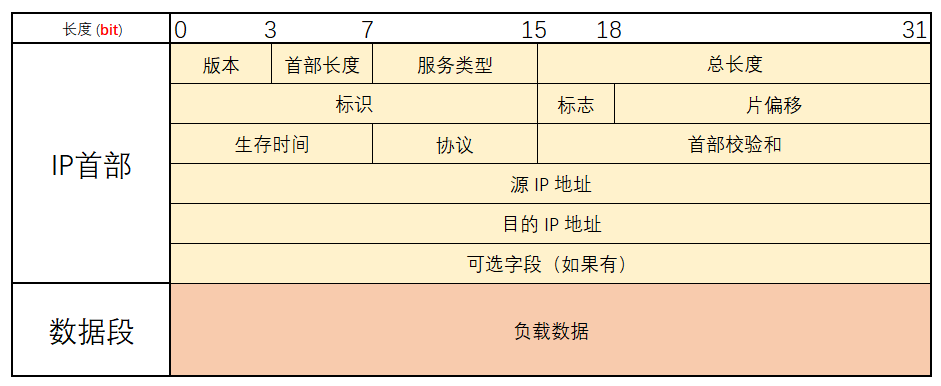
- 版本 (4 bits): IP 版本号, IPv4 = 4, IPv6 = 6.
- 首部长度 (4 bits): 以 32bit (4 字节) 为一个单位的首部长度, 首部长度一般填 5, 即 20 字节的长度.
- 服务类型 (8 bits): 默认为 0 就行, 用于一般服务.
- 总长度 (16 bits): 整个 IP 数据报的长度 (首部 + 数据段), 以字节为单位.
- 标识 (16 bits): 标识符, 用于分片重组
- 标志 (3 bits):
- bit2: 保留位
- bit1: 填 1 表示禁止分片, 填 0 表示允许分片
- bit0: 若为分片包的最后一个包就填0, 否则为 1
- 片偏移 (13 bits): 用于接收端重组报文
- 生存时间 (8 bits): 英文简称 TTL(Time To Live), 指 IP 报文在网络传输中可以通过网络交换机的次数, 若超过这个次数则交换机会将本次的 IP 报丢弃。作用是防止 IP 数据报在网络中长时间传输导致网络瘫痪。常用值: 64/128
- 协议 (4 bits): 上层协议 (ICMP=1, TCP=6, UDP=17)
- 首部校验和: 首部校验和, 计算方式在下文, 快捷链接: [首部校验和计算方法]
- 源 IP 地址: 发送方的 IP 地址
- 目的 IP 地址: 接收方的 IP 地址
- 可选字段: 可变, 0-40 字节的长度, 需对齐至 32 位 (4字节) 边界。但在现代网络通信中这段内容几乎用不到。
- 负载数据: 用户传输的负载数据, ICMP、UDP、TCP 的首部数据和负载数据均在这段内容中。
首部校验和计算方法
IP 首部校验和用于检测 IP 数据报首部在传输过程中是否出现错误。它只覆盖 IP 首部(不包括数据部分), 且采用 16 位反码求和 算法。
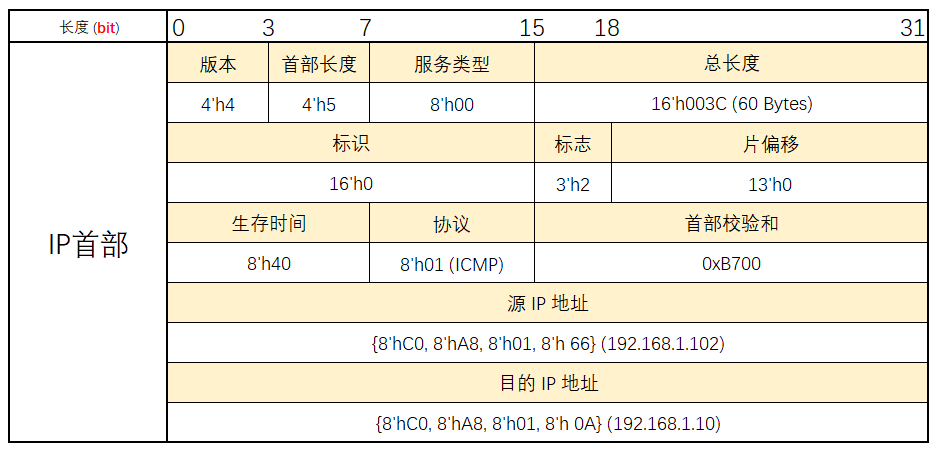
假设我们的 IP 首部数据经过填充后如下图所示。
计算前的准备
- 将校验和字段清零: 在计算校验和之前, IP 首部中的 “首部校验和” 字段 (16 位) 必须设置为
0x0000, 保证此段不参与计算。 - 将所有数据按照每 16-bit(2 字节) 为划分为一个半字(Half-Word): 将整个 IP 首部 (通常是 20 字节, 不含选项, 或更多带选项的情况) 按每 2 字节为一个单位, 拆分成若干个 半字。
计算步骤
- 累加所有的半字: 将所有这些 16 位数值进行普通的二进制加法 (允许进位到 17 位或更高, 并非取模值)。
以下是计算示例 (箭头所指的值为上一步骤的计算结果):
0x4500 + 0x003C = 0x453C-> 0x453C + 0x0000 = 0x453C-> 0x453C + 0x4000 = 0x853C-> 0x853C + 0x4001 = 0xC53D-> 0xC53D + 0x0000 = 0xC53D-> 0xC53D + 0xC0A8 = 0x185E5 (产生进位, 结果是 0x185E5, 即高 16 位 = 0x0001, 低 16 位 = 0x85E5)-> 0x185E5 + 0x0166 = 0x1874B (高 16 位 = 0x0001, 低 16 位 = 0x874B)-> 0x1874B + 0xC0A8 = 0x247F3 (高 16 位 = 0x0002, 低 16 位 = 0x47F3)-> 0x247F3 + 0x010A = 0x248FD (高 16 位 = 0x0002, 低 16 位 = 0x48FD)最终累加结果为 0x2_48FD (即高 16 位 0x0002, 低 16 位 0x48FD)。
- 处理进位: 如果高 16 位不为 0, 则将其与低 16 位相加, 重复此步骤直到高 16 位结果为 0。
0x0002 + 0x48FD = 0x48FF此时高 16 位为 0x0000, 停止计算。中间结果 0x48FF 称为 反码求和 的中间值。
- 按位取反: 将最终的 16 位中间值
0x48FF按位取反:~0x48FF = 0xB700, 由此我们得到了最终的校验和0xB700, 这个值就是需要填入 IP 首部校验和字段的值。
为什么要折叠进位?
普通的加法会产生进位, 而反码求和算法通过把进位加回到低位, 保证了最终结果是一个 16 位数, 并且这种操作等价于 以 65535 为模的补码加法。
这样设计的好处是: 接收方可以用同样的方法计算 (包括校验和字段在内), 如果最终结果是 0xFFFF, 则说明首部无错。
接收方的验证方法
接收方收到 IP 数据报后, 也将整个首部 (包含校验和字段在内) 用相同的方法进行 16 位反码求和。
- 若首部没有错误, 计算得到的最终结果应该是
0xFFFF。 - 如果不是
0xFFFF, 则接收方应该丢弃这个数据报 (或通知上层)。
下面是接收方计算示例:
0x4500 + 0x003C = 0x453C-> 0x453C + 0x0000 = 0x453C-> 0x453C + 0x4000 = 0x853C-> 0x853C + 0x4001 = 0xC53D-> 0xC53D + 0xB700 = 0x17C3D (0xB700: 在接收方参与和计算, 高 16 位 = 0x0001, 低 16 位 = 0x7C3D)-> 0x17C3D + 0xC0A8 = 0x23CE5 (高 16 位 = 0x0002, 低 16 位 = 0x3CE5)-> 0x23CE5 + 0x0166 = 0x23E4B (高 16 位 = 0x0002, 低 16 位 = 0x3E4B)-> 0x23E4B + 0xC0A8 = 0x2FEF3 (高 16 位 = 0x0002, 低 16 位 = 0xFEF3)-> 0x2FEF3 + 0x010A = 0x2FFFD (高 16 位 = 0x0002, 低 16 位 = 0xFFFD)将高 16 位结果和低 16 位结果相加取和得到最终结果 0xFFFF, 表明首部数据没有错误。
0x0002 + 0xFFFD = 0xFFFF实现代码
IP 解包模块
其工作方式同样是流式握手控制协议。从这部分开始的模块有两个握手接口, 一个是与上游的网络解包模块接口握手来接收包含 IP 首部和负载的数据, 模块负责从中分离 IP 首部并解析; 另外一个握手接口是与下游模块 (通常是 IP 协议的上层协议模块, 如 UDP、TCP) 握手发送数据, 将 IP 数据段中的负载数据发送给下游模块。
这里偷懒了没做接收方的数据校验😜。有能力的朋友可以自己做一下, 后面有时间的话我再实现吧。
module ip_decap( input wire clk , // [I] [ ] Module clock input wire rst_n , // [I] [ ] Module reset signal, active-low
input wire [15:00] eth_type , // [I] [15:00] received ethertype input wire [31:00] board_ip , // [I] [31:00] board ip address, for comparison whith received destination ip address
// upstream: ethernet pack decapsulation input wire decap_busy , // [I] [ ] decapsulation module busy state input input wire [07:00] s_axis_rd , // [I] [07:00] axis receive data input from decapsulation module input wire s_axis_rdv , // [I] [ ] axis receive data valid input from decapsulation module input wire s_axis_rend , // [I] [ ] axis receive tend input from decapsulation module output reg s_axis_rrdy , // [O] [ ] axis receive ready signal
// Received IP payload output, to downstream: tcp/udp/icmp input wire s_ip_axis_rrdy , // [I] [ ] IP downstream rx ready output reg [07:00] s_ip_axis_rd , // [O] [07:00] IP data received output output reg s_ip_axis_rdv , // [O] [ ] IP data valid output, active-high output reg s_ip_axis_rend , // [O] [ ] IP data output end
// IP Header output output reg ip_valid , // [O] [ ] Active-high only received destination ip address is board-ip output reg [03:00] ip_version , // [O] [03:00] IP version, 4'b4: ipv4, 4'b6: ipv6 output reg [03:00] ip_header_len , // [O] [03:00] IP header length, In units of 32 bits (4 bytes). output reg [07:00] ip_tos , // [O] [07:00] IP type of service output reg [15:00] ip_total_len , // [O] [15:00] IP total length (include payload) output reg [15:00] ip_id , // [O] [15:00] IP identification output reg [02:00] ip_flag , // [O] [02:00] IP Flag, bit2: reserved, bit1: 1'b1 is allowing fragmentation, else disallowing. bit0: 1'b1 is more frame, 1'b0 is the last frame. output reg [12:00] ip_fragment_offset , // [O] [12:00] IP fragment offset146 collapsed lines
output reg [07:00] ip_ttl , // [O] [07:00] IP time to live output reg [07:00] ip_ul_protocol , // [O] [07:00] IP upper-layer protocol (ICMP = 8'd1, TCP=8'd6, UDp=8'd17) output reg [15:00] ip_checksum , // [O] [15:00] IP checksum output reg [31:00] ip_src_addr , // [O] [31:00] Source ip address output reg [31:00] ip_dst_addr // [O] [31:00] Destination ip address);
//================================================================================// Local Parameter Declarations//================================================================================localparam IP_ETH_TYPE = 16'h0800 ;
// state defineslocalparam ST_IDLE = 3'd0 ;localparam ST_IP_HEADER = 3'd1 ;localparam ST_IP_PAYLOAD = 3'd2 ;localparam ST_IP_END = 3'd3 ;
//================================================================================// Register Declarations//================================================================================reg [03:00] state ;reg [15:00] bytes_rx_cnt ;
//================================================================================// Wire Declarations//================================================================================
//================================================================================// Assign Declarations//================================================================================
//================================================================================// implements//================================================================================
//================================================================================// MAIN CODE//================================================================================always @(posedge clk or negedge rst_n) begin if (!rst_n) begin state <= ST_IDLE ; bytes_rx_cnt <= 16'd0 ; ip_version <= 4'b0 ; ip_header_len <= 4'b0 ; ip_tos <= 8'b0 ; ip_total_len <= 16'b0 ; ip_id <= 16'b0 ; ip_flag <= 3'b0 ; ip_fragment_offset <= 13'b0 ; ip_ttl <= 8'b0 ; ip_ul_protocol <= 8'b0 ; ip_checksum <= 16'b0 ; ip_src_addr <= 32'b0 ; ip_dst_addr <= 32'b0 ;
s_axis_rrdy <= 1'b0 ; s_ip_axis_rend <= 1'b0 ; s_ip_axis_rd <= 8'b0 ; s_ip_axis_rdv <= 1'b0 ; ip_valid <= 1'b0 ; end else begin case (state) ST_IDLE: begin bytes_rx_cnt <= 16'd0 ;
s_axis_rrdy <= 1'b1 ; s_ip_axis_rend <= 1'b0 ; s_ip_axis_rd <= 8'b0 ; s_ip_axis_rdv <= 1'b0 ; ip_valid <= 1'b0 ;
if ( eth_type == IP_ETH_TYPE && // upstream received ip packet s_axis_rdv == 1'b1 ) begin state <= ST_IP_HEADER ;
ip_version <= s_axis_rd[7:4] ; // pre receive 1 bytes ip_header_len <= s_axis_rd[3:0] ; bytes_rx_cnt <= bytes_rx_cnt + 1'b1 ; end else begin state <= ST_IDLE ; end end
ST_IP_HEADER: begin bytes_rx_cnt <= bytes_rx_cnt + 1'b1 ; case (bytes_rx_cnt) 16'd1: ip_tos <= s_axis_rd ; 16'd2: ip_total_len[15:8] <= s_axis_rd ; 16'd3: ip_total_len[07:0] <= s_axis_rd ; 16'd4: ip_id[15:08] <= s_axis_rd ; 16'd5: ip_id[07:00] <= s_axis_rd ;
16'd6: begin ip_flag <= s_axis_rd[7:4] ; ip_fragment_offset[12:8]<= s_axis_rd[4:0] ; end
16'd7: ip_fragment_offset[7:0] <= s_axis_rd ; 16'd8: ip_ttl <= s_axis_rd ; 16'd9: ip_ul_protocol <= s_axis_rd ; 16'd10: ip_checksum[15:08] <= s_axis_rd ; 16'd11: ip_checksum[07:00] <= s_axis_rd ; 16'd12: ip_src_addr[31:24] <= s_axis_rd ; 16'd13: ip_src_addr[23:16] <= s_axis_rd ; 16'd14: ip_src_addr[15:08] <= s_axis_rd ; 16'd15: ip_src_addr[07:00] <= s_axis_rd ; 16'd16: ip_dst_addr[31:24] <= s_axis_rd ; 16'd17: ip_dst_addr[23:16] <= s_axis_rd ; 16'd18: ip_dst_addr[15:08] <= s_axis_rd ; 16'd19: ip_dst_addr[07:00] <= s_axis_rd ;
default: begin // 26.4.8 add: dest ip check if (ip_dst_addr == board_ip) begin state <= ST_IP_PAYLOAD ; // 1if received dst ip is board ip, receive payload ip_valid <= 1'b1 ; s_ip_axis_rdv <= 1'b1 ; s_ip_axis_rd <= s_axis_rd ; // pre-fill 1 byte end else begin state <= ST_IP_END ; // or else, drop this packet ip_valid <= 1'b0 ; end end endcase end
ST_IP_PAYLOAD: begin s_ip_axis_rd <= s_axis_rd ; if (s_axis_rdv == 1'b0 ) begin s_ip_axis_rd <= 8'b0 ; s_ip_axis_rdv <= 1'b0 ; s_ip_axis_rend <= 1'b1 ; state <= ST_IP_END ; end end
ST_IP_END: begin s_ip_axis_rend <= 1'b0 ; state <= ST_IDLE ; end endcase endend
endmoduleIP 封包模块
同样是两个握手接口, 一个接口负责接收来自上游模块 (UDP、TCP模块) 的数据, 一个接口用来将封装好的数据发送到下游模块 (以太网封包模块)。
module ip_encap ( input wire clk , // [I] [ ] Module clock input wire rst_n , // [I] [ ] Module reset signal, active-low
// downstream: ethernet pack encapsulation input wire encap_busy , // [I] [ ] encapsulation module busy state input, we only send packet when this signal is 1'b0 output reg [07:00] s_axis_td , // [O] [07:00] axis send data output to encapsulation module output reg s_axis_tdv , // [O] [ ] axis send data valid output to encapsulation module output wire s_axis_tend , // [O] [ ] axis send tend output to encapsulation module input wire s_axis_trdy , // [I] [ ] axis send ready signal
// upstream: tcp/udp/icmp tx output input wire [07:00] s_ip_axis_td , // [I] [07:00] IP data AXI-Stream input input wire s_ip_axis_tdv , // [I] [ ] IP data send valid, active-high input wire s_ip_axis_tend , // [I] [ ] IP data send end output reg s_ip_axis_trdy , // [O] [ ] IP data send ready
// IP header input wire [15:00] data_length , // [I] [15:00] Data segment length in bytes input wire [07:00] ip_ttl , // [I] [07:00] Time to live. input wire [07:00] ip_ul_protocol , // [I] [07:00] Upper-layer protocol, (ICMP=8'd1, TCP=8'd6, UDP=8'd17) input wire [31:00] ip_src_ip , // [I] [31:00] Source ip address input wire [31:00] ip_dst_ip , // [I] [31:00] Destination ip address
// States output output reg ip_tx_err_busy // [O] [ ] TX error when dowmstream encapsulation module is busy, at this time, upstream must stop transmission.);137 collapsed lines
//================================================================================// Local Parameter Declarations//================================================================================localparam IP_VERSION = 4'h4 ; // ipv4localparam IP_HEADER_LENGTH = 4'h5 ; // header length 5, 20 bytes in total.localparam IP_TOS = 8'h00 ;
// state defineslocalparam ST_IDLE = 4'b0 ;localparam ST_CHECKSUM = 4'd1 ;localparam ST_CHECKSUM_CHECK = 4'd2 ;localparam ST_IP_TX_TRIG = 4'd3 ;localparam ST_IP_PAYLOAD = 4'd4 ;localparam ST_IP_END = 4'd5 ;
//================================================================================// Register Declarations//================================================================================reg [03:00] state ;reg [31:00] ip_header [4:0] ; // ip header: 20 bytesreg [04:00] ip_header_index ; // for checksum and header transmissionreg [31:00] checksum_buffer ;reg [15:00] cnt ; // a counter
//================================================================================// Wire Declarations//================================================================================wire [15:00] total_length ; // total ip packet length, include header and data segment
//================================================================================// Assign Declarations//================================================================================assign total_length = ((IP_HEADER_LENGTH*4) + data_length) ;assign s_axis_tend = s_ip_axis_tend ;
//================================================================================// implements//================================================================================
//================================================================================// MAIN CODE//================================================================================always @(posedge clk or negedge rst_n) begin if (!rst_n) begin state <= ST_IDLE ; cnt <= 16'd0 ;
ip_header[0] <= 32'b0 ; ip_header[1] <= 32'b0 ; ip_header[2] <= 32'b0 ; ip_header[3] <= 32'b0 ; ip_header[4] <= 32'b0 ; ip_header_index <= 5'd00 ; checksum_buffer <= 32'b0 ;
s_axis_tdv <= 1'b0 ; s_axis_td <= 8'b0 ; s_ip_axis_trdy <= 1'b0 ;
ip_tx_err_busy <= 1'b0 ; end else begin case(state) ST_IDLE: begin s_ip_axis_trdy <= 1'b0 ; if (encap_busy == 1'b1) begin ip_tx_err_busy <= 1'b1 ; end else if (s_ip_axis_tdv == 1'b1) begin ip_tx_err_busy <= 1'b0 ; // pre fill buffer, in order to calculate checksum. ip_header[0] <= {IP_VERSION, IP_HEADER_LENGTH, IP_TOS, total_length}; ip_header[1][31:16] <= ip_header[1][31:16] + 1'b1 ; // id, auto increment by 1 ip_header[1][15:13] <= 3'b010 ; // No fragment ip_header[1][12:00] <= 13'd00 ; // Fragment offset ip_header[2][31:24] <= ip_ttl ; // TTL ip_header[2][23:16] <= ip_ul_protocol ; // Upper-layer protocol, (ICMP=8'd1, TCP=8'd6, UDP=8'd17) ip_header[2][15:00] <= 16'h0000 ; // IP header checksum, temporarily is 0 ip_header[3] <= ip_src_ip ; // Source ip address ip_header[4] <= ip_dst_ip ; // Destination ip address
state <= ST_CHECKSUM ; end end
ST_CHECKSUM: begin checksum_buffer <= ip_header[0][31:16] + ip_header[0][15:00] + ip_header[1][31:16] + ip_header[1][15:00] + ip_header[2][31:16] + ip_header[2][15:00] + ip_header[3][31:16] + ip_header[3][15:00] + ip_header[4][31:16] + ip_header[4][15:00] ; state <= ST_CHECKSUM_CHECK ; end
ST_CHECKSUM_CHECK: begin if (checksum_buffer[31:16] == 16'h0000) begin // Accumulate until the high 16 bits are 0. ip_header[2][15:00] <= ~checksum_buffer[15:00] ; // The final result is bitwise negated. state <= ST_IP_TX_TRIG ; // Goto next state
s_axis_tdv <= 1'b1 ; // downstream: frame encapsulation tx valid, then wait trdy signal // s_axis_td <= ip_header[0][31:24] ; // cnt <= 15'd1 ; end else begin checksum_buffer <= checksum_buffer[31:16] + checksum_buffer[15:00]; end end
ST_IP_TX_TRIG: begin if (s_axis_trdy == 1'b1) begin cnt <= cnt + 1'b1 ; s_axis_td <= ip_header[cnt[15:2]][((3 - cnt[1:0])*8)+:8]; if (cnt == IP_HEADER_LENGTH*4 - 1) begin cnt <= 16'd0 ; state <= ST_IP_PAYLOAD ; // s_axis_td <= s_ip_axis_td ; end else if (cnt == IP_HEADER_LENGTH*4 - 2) begin s_ip_axis_trdy <= 1'b1 ; end end end
ST_IP_PAYLOAD: begin s_axis_td <= s_ip_axis_td ; if (s_ip_axis_tend == 1'b1) begin s_axis_tdv <= 1'b0 ; s_axis_td <= 8'b00 ; s_ip_axis_trdy <= 1'b0 ; state <= ST_IP_END ; end end
ST_IP_END: begin state <= ST_IDLE ; end endcase endend
endmoduleIP 协议顶层
这个模块作为一个顶层例化了封包和解包两个子模块, 方便在其它上层模块中进行调用。
module ip( input wire tx_clk , // [I] [ ] Module tx clock input wire rx_clk , // [I] [ ] Module rx clock input wire rst_n , // [I] [ ] Module reset signal, active-low
input wire [15:00] ip_rx_eth_type , // [I] [15:00] received ethertype input wire [31:00] board_ip , // [I] [31:00] board ip address, for comparison whith received destination ip address
// ip encap // downstream: ethernet pack encapsulation input wire encap_busy , // [I] [ ] encapsulation module busy state input, we only send packet when this signal is 1'b0 output wire [07:00] s_axis_td , // [O] [07:00] axis send data output to encapsulation module output wire s_axis_tdv , // [O] [ ] axis send data valid output to encapsulation module output wire s_axis_tend , // [O] [ ] axis send tend output to encapsulation module input wire s_axis_trdy , // [I] [ ] axis send ready signal
// IP payload output, to downstream: tcp/udp/icmp output wire s_ip_axis_trdy , // [I] [ ] IP downstream rx ready input wire [07:00] s_ip_axis_td , // [O] [07:00] IP data AXI-Stream output input wire s_ip_axis_tdv , // [O] [ ] IP data output valid, active-high input wire s_ip_axis_tend , // [O] [ ] IP data output end
input wire [15:00] ip_encap_data_length , // [I] [15:00] Data segment length in bytes input wire [07:00] ip_encap_ttl , // [I] [07:00] Time to live. input wire [07:00] ip_encap_ul_protocol , // [I] [07:00] Upper-layer protocol, (ICMP=8'd1, TCP=8'd6, UDP=8'd17) input wire [31:00] ip_encap_src_ip , // [I] [31:00] Source ip address input wire [31:00] ip_encap_dst_ip , // [I] [31:00] Destination ip address
output wire ip_encap_tx_err_busy , // [O] [ ] TX error when dowmstream encapsulation module is busy, at this time, upstream must stop transmission.
// ip decap // upstream: ethernet pack decapsulation input wire decap_busy , // [I] [ ] decapsulation module busy state input input wire [07:00] s_axis_rd , // [I] [07:00] axis receive data input from decapsulation module input wire s_axis_rdv , // [I] [ ] axis receive data valid input from decapsulation module input wire s_axis_rend , // [I] [ ] axis receive tend input from decapsulation module output wire s_axis_rrdy , // [O] [ ] axis receive ready signal
input wire s_ip_axis_rrdy , // [I] [ ] IP downstream rx ready output wire [07:00] s_ip_axis_rd , // [O] [07:00] IP data received output output wire s_ip_axis_rdv , // [O] [ ] IP data valid output, active-high output wire s_ip_axis_rend , // [O] [ ] IP data output end
// output received ip header output wire ip_valid , // [O] [ ] Active-high only received destination ip address is board-ip output wire [03:00] ip_decap_version , // [O] [03:00] IP version, 4'b4: ipv4, 4'b6: ipv6 output wire [03:00] ip_decap_header_len , // [O] [03:00] IP header length, In units of 32 bits (4 bytes). output wire [07:00] ip_decap_tos , // [O] [07:00] IP type of service output wire [15:00] ip_decap_total_len , // [O] [15:00] IP total length (include payload) output wire [15:00] ip_decap_id , // [O] [15:00] IP identification output wire [02:00] ip_decap_flag , // [O] [02:00] IP Flag, bit2: reserved, bit1: 1'b1 is allowing fragmentation, else disallowing. bit0: 1'b1 is more frame, 1'b0 is the last frame. output wire [12:00] ip_decap_fragment_offset , // [O] [12:00] IP fragment offset output wire [07:00] ip_decap_ttl , // [O] [07:00] IP time to live output wire [07:00] ip_decap_ul_protocol , // [O] [07:00] IP upper-layer protocol (ICMP = 8'd1, TCP=8'd6, UDp=8'd17) output wire [15:00] ip_decap_checksum , // [O] [15:00] IP checksum output wire [31:00] ip_decap_src_addr , // [O] [31:00] Source ip address output wire [31:00] ip_decap_dst_addr // [O] [31:00] Destination ip address);
ip_encap ip_encap_inst (25 collapsed lines
.clk ( tx_clk ), // [I] [ ] Module clock .rst_n ( rst_n ), // [I] [ ] Module reset signal, active-low
// downstream: ethernet pack encapsulation .encap_busy ( encap_busy ), // [I] [ ] encapsulation module busy state input, we only send packet when this signal is 1'b0 .s_axis_td ( s_axis_td ), // [O] [07:00] axis send data output to encapsulation module .s_axis_tdv ( s_axis_tdv ), // [O] [ ] axis send data valid output to encapsulation module .s_axis_tend ( s_axis_tend ), // [O] [ ] axis send tend output to encapsulation module .s_axis_trdy ( s_axis_trdy ), // [I] [ ] axis send ready signal
// upstream: tcp/udp/icmp tx output .s_ip_axis_td ( s_ip_axis_td ), // [I] [07:00] IP data AXI-Stream input .s_ip_axis_tdv ( s_ip_axis_tdv ), // [I] [ ] IP data receive valid, active-high .s_ip_axis_tend ( s_ip_axis_tend ), // [I] [ ] IP data receive end .s_ip_axis_trdy ( s_ip_axis_trdy ), // [O] [ ] IP data receive ready
// IP header .data_length ( ip_encap_data_length ), // [I] [15:00] Data segment length in bytes .ip_ttl ( ip_encap_ttl ), // [I] [07:00] Time to live. .ip_ul_protocol ( ip_encap_ul_protocol ), // [I] [07:00] Upper-layer protocol, (ICMP=8'd1, TCP=8'd6, UDP=8'd17) .ip_src_ip ( ip_encap_src_ip ), // [I] [31:00] Source ip address .ip_dst_ip ( ip_encap_dst_ip ), // [I] [31:00] Destination ip address
// States output .ip_tx_err_busy ( ip_encap_tx_err_busy ) // [O] [ ] TX error when dowmstream encapsulation module is busy, at this time, upstream must stop transmission.);
ip_decap ip_decap_inst (31 collapsed lines
.clk ( rx_clk ), // [I] [ ] Module clock .rst_n ( rst_n ), // [I] [ ] Module reset signal, active-low .eth_type ( ip_rx_eth_type ), // [I] [15:00] received ethertype .board_ip ( board_ip ), // [I] [31:00] board ip address, for comparison whith received destination ip address // upstream: ethernet pack decapsulation .decap_busy ( decap_busy ), // [I] [ ] decapsulation module busy state input .s_axis_rd ( s_axis_rd ), // [I] [07:00] axis receive data input from decapsulation module .s_axis_rdv ( s_axis_rdv ), // [I] [ ] axis receive data valid input from decapsulation module .s_axis_rend ( s_axis_rend ), // [I] [ ] axis receive tend input from decapsulation module .s_axis_rrdy ( s_axis_rrdy ), // [O] [ ] axis receive ready signal
// IP payload output, to downstream: tcp/udp/icmp .s_ip_axis_rrdy ( s_ip_axis_rrdy ), // [I] [ ] IP downstream rx ready .s_ip_axis_rd ( s_ip_axis_rd ), // [O] [07:00] IP data AXI-Stream output .s_ip_axis_rdv ( s_ip_axis_rdv ), // [O] [ ] IP data output valid, active-high .s_ip_axis_rend ( s_ip_axis_rend ), // [O] [ ] IP data output end
// output received ip header .ip_valid ( ip_valid ), // [O] [ ] Active-high only received destination ip address is board-ip .ip_version ( ip_decap_version ), // [O] [03:00] IP version, 4'b4: ipv4, 4'b6: ipv6 .ip_header_len ( ip_decap_header_len ), // [O] [03:00] IP header length, In units of 32 bits (4 bytes). .ip_tos ( ip_decap_tos ), // [O] [07:00] IP type of service .ip_total_len ( ip_decap_total_len ), // [O] [15:00] IP total length (include payload) .ip_id ( ip_decap_id ), // [O] [15:00] IP identification .ip_flag ( ip_decap_flag ), // [O] [02:00] IP Flag, bit2: reserved, bit1: 1'b1 is allowing fragmentation, else disallowing. bit0: 1'b1 is more frame, 1'b0 is the last frame. .ip_fragment_offset ( ip_decap_fragment_offset ), // [O] [12:00] IP fragment offset .ip_ttl ( ip_decap_ttl ), // [O] [07:00] IP time to live .ip_ul_protocol ( ip_decap_ul_protocol ), // [O] [07:00] IP upper-layer protocol (ICMP = 8'd1, TCP=8'd6, UDp=8'd17) .ip_checksum ( ip_decap_checksum ), // [O] [15:00] IP checksum .ip_src_addr ( ip_decap_src_addr ), // [O] [31:00] Source ip address .ip_dst_addr ( ip_decap_dst_addr ) // [O] [31:00] Destination ip address);
endmodule